
Why Your M.Ed. Concentration Matters
A master’s degree in education, also known as an M.Ed., provides a pathway for educators and education professionals to advance their careers with deeper knowledge and practical leadership skills. Some M.Ed. programs cover broader aspects of education, like:
- Curriculum and instruction
- Educational leadership
- Technology
- Early childhood education
However, many M.Ed. specializations enhance an educator’s niche or content area expertise in areas like:
- Mathematics
- Special education
Why are M.Ed. concentrations important? They allow you to focus your advanced degree on not only what you want to learn, but the skills you need to reach your career goals. Your specialization determines how you aspire to apply your knowledge.
Choosing the right M.Ed. program to get there is a critical component of taking you to the next level. Your master’s degree has the potential to shape job opportunities, affect salary potential and, ultimately, build a satisfying career in the field of education.
What Is an Educational Specialization in an M.Ed. Program?
An educational specialization is essentially a concentration or focus of study. It provides the opportunity for you to tailor the courses you take to align with your goals.
There are opportunities to earn general M.Ed. degrees that equip you with broad, foundational information across topics, but a specialization is the key to focused areas in education like curriculum development, education administration or instructional design. They’re both quality pathways to educational leadership, but when you select a master’s in education concentration, it allows you to meet more specific student learning needs.
Popular M.Ed. Concentrations & What They Mean
Each specialization leads to unique M.Ed. career paths, from instructional design to school administration. In my career as an instructor of graduate-level education courses, I’ve found certain concentrations to be the most popular.
| Concentration | Learning Outcomes | Example Roles |
| Curriculum and instruction | Design and improve education programs and classroom strategies | Instructional coach, curriculum developer, lead teacher |
| Educational leadership | Build leadership skills like decision-making, policy development and more | Principal, department head, school district administration |
| Special education | Support the developmental and academic growth of students with disabilities | Special education teacher, inclusion specialist, IEP coordinator |
| Higher education | Understand success strategies and evidence-based practices for postsecondary settings | Academic advisor, student life director, registrar |
| Adult learning and training | Train and develop adult learners in corporate or academic environments | Corporate trainer, learning and development specialist, talent manager |
| Instructional design and educational technology | Lead technology and instruction initiatives that enhance student outcomes | Instructional designer, technology specialist, e-learning developer |
| Literacy | Guide students in literacy development and reading achievement | Reading specialist, literacy coach, interventionist |
How to Choose the Right Concentration for Your Career Goals
There are various considerations to keep in mind when selecting your concentration. Ask yourself the following questions to get started.
- What are your career aspirations and educational goals? Consider roles you want to work toward and their accompanying education requirements, like a master’s or doctoral degree.
- What are your passions and interests? Think about what you love about your role in education and build upon that.
- What roles are in demand, and do you want to fill those positions? Explore staffing needs in your school district or wherever you want to work.
- Do you want broad skills or niche expertise? Determine whether you’re interested in a specific sector of education or a more flexible, general path.
- Are there M.Ed. programs available in your specialization of interest that fit in your schedule and budget? Not all universities and colleges offer the same concentrations. American College of Education (ACE) offers several fully online* M.Ed. programs at industry-low costs.
Tips on Choosing Your M.Ed. Specialization
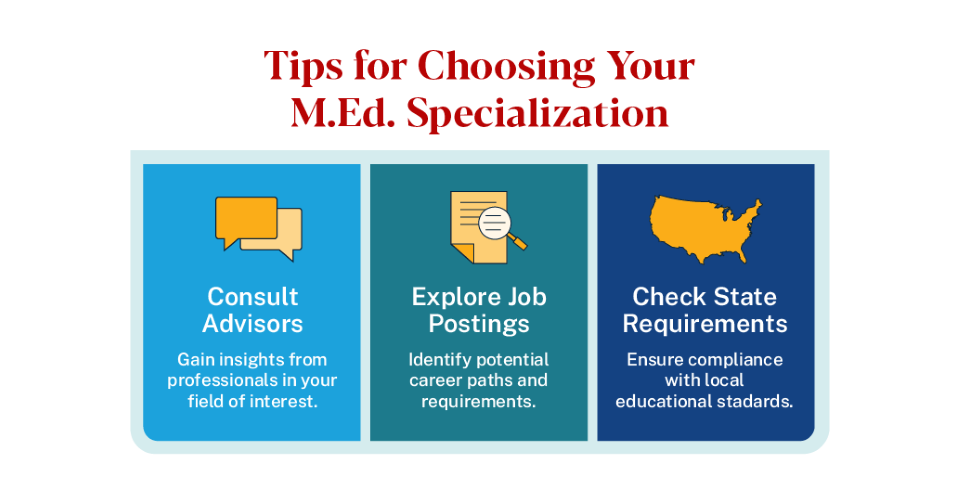
One of the most powerful tips for choosing a specialization is research. Consult with advisors or professionals in your area of interest. Explore job postings and their requirements to see if anything catches your eye. Take note of state requirements where you are or would like to work.
FAQs
What is the difference between an M.Ed. and MAT?
An M.Ed. is a master of education degree and is designed for those seeking advanced or specialized roles that focus on broader aspects of education like leadership, curriculum, technology and more. An MAT is a master of arts in teaching degree that is more classroom centered. It’s for current or aspiring educators who want to enhance their teaching practice or pursue teaching as a second career.
Which M.Ed. concentration has the best job outlook?
This often depends on location, demand and other factors. However, from what I’m observing in our current landscape, it looks like special education, instructional design, technology and leadership are some of the most needed specialties across the United States.
Can I change my M.Ed. concentration later?
In many cases, you can. Each college and university approaches this differently based on its policies. Note that changing concentrations can require additional credits or delay graduation, so the best path is to decide as early as possible.
ACE offers fully online* M.Ed. programs in various concentrations that can get you to the next level of your career in an affordable, quality way.
*Select programs may require student teaching, an internship or practicum.