
Writing a research paper requires more than presenting ideas and supporting them with evidence. Knowing how to cite a research paper is a core academic writing skill that gives credit to the original authors behind the information you use.
Proper citations and clear writing help you avoid plagiarism, build credibility in academic writing and make it easier for readers to trace your sources. Understanding what citations include and how to use different styles can help you cite references with confidence.
What Is a Citation in Writing?
Citations identify the sources used in your paper. Most academic writing includes two types: in-text citations within the body of the paper and a reference list or Works Cited page with complete publication information for each source.
Why Citing Sources Matters
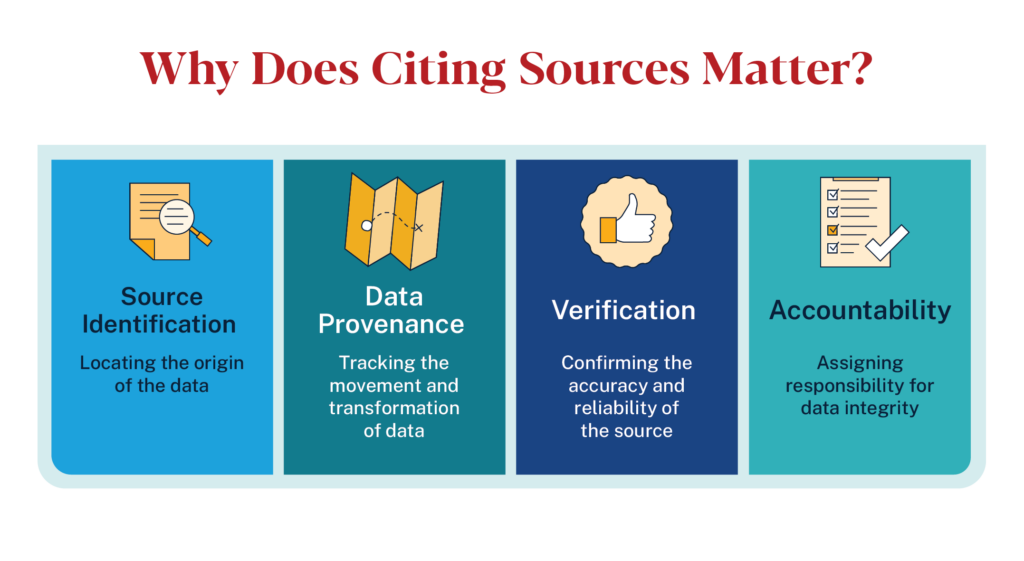
Citing sources does more than satisfy a formatting requirement. Proper citations help you:
- Give credit to the original author for their ideas and research
- Avoid plagiarism by clearly identifying information that came from another researcher
- Strengthen your academic writing by supporting your claims with credible evidence
- Help readers find the sources you used to learn more or verify your information
When Do You Need to Cite a Source?
You should cite a source any time you use information, ideas or creative work that isn’t your own. That includes:
- Direct quotations enclosed in quotation marks
- Paraphrased or summarized ideas
- Statistics, data or research findings
- Charts, graphs, tables, images or figures created by someone else
It’s a common misconception that only direct quotes require citations. Even when you put someone else’s ideas into your own words, you still need to credit the original source. A citation acknowledges where the information came from, regardless of how it’s presented.
What Information Does a Citation Include?
While citation styles differ, most citations include the same basic information:
- Author’s name
- Title of the work
- Publication date
- Publisher or source
- Location within the work (page, paragraph, etc.)
How these elements are ordered and formatted depends on the citation style you’re using.
How to Properly Cite a Source in APA Style
American Psychological Association (APA) style is one of the most widely used citation styles, particularly in education, social sciences, healthcare and business. It provides guidelines for both in-text citations and reference list entries.
APA In-Text Citations
APA uses parenthetical citations that typically include the author’s last name and publication year.
Example:
- Proper citation practices improve academic writing skills (Smith, 2026)
You can also use a narrative citation by incorporating the author’s name into the sentence, followed by the publication year in parentheses.
Example:
- Smith (2026) found that proper citation practices improve academic writing skills
When using a direct quotation, APA also recommends including the page number whenever available.
Example:
- “Proper citation practices improve academic writing skills” (Smith, 2026, p. 45)
APA Reference List Formatting
APA reference list entries should appear on a page titled “References” at the end of your paper. Every source cited in the text should appear in the reference list, and every source in the reference list should be cited in the text.
Entries are alphabetized by the author’s last name.
A basic journal article reference follows this general structure:
- Author, A. A. (Year). Title of article. Journal Name, Volume(Issue), page range. URL if applicable
An example, if this article was published in the fictional ACE Monthly:
- Smith, A. B. (2026). How to cite a research paper. ACE Monthly, 15(2), 14-29. https://ace.edu/page-name-here
How to Properly Cite a Source in MLA Style
Modern Language Association (MLA) style is commonly used in literature, language arts, history and other humanities disciplines. It provides guidelines for formatting both in-text citations and your Works Cited page.
MLA In-Text Citations
MLA uses parenthetical citations that include the author’s last name and page number, making it easy for readers to locate the exact passage you’re referencing. This is also used for direct quotations.
Examples:
- Accurate citations strengthen academic credibility (Smith 123)
- “Accurate citations strengthen academic credibility” (Smith 123)
If you mention the author’s name in your sentence, include only the page number in parentheses.
Example:
- Smith argues that accurate citations strengthen academic credibility (123)
MLA Works Cited Page Formatting
MLA requires a page titled “Works Cited” at the end of your paper. Entries are alphabetized by the author’s last name.
A basic journal article citation follows this general structure:
- Last Name, First Name. “Article Title.” Journal Name, vol. number, no. number, year, pp. Pages. URL.
An example, if this article was published in the fictional ACE Monthly:
- Smith, Angela. “How to Cite a Research Paper.” ACE Monthly, vol. 15, no. 2, 2026, pp. 14–29. https://ace.edu/page-name-here.
Common Citation Mistakes to Avoid
A few common citation mistakes can affect the accuracy and credibility of your paper. Watch for errors like:
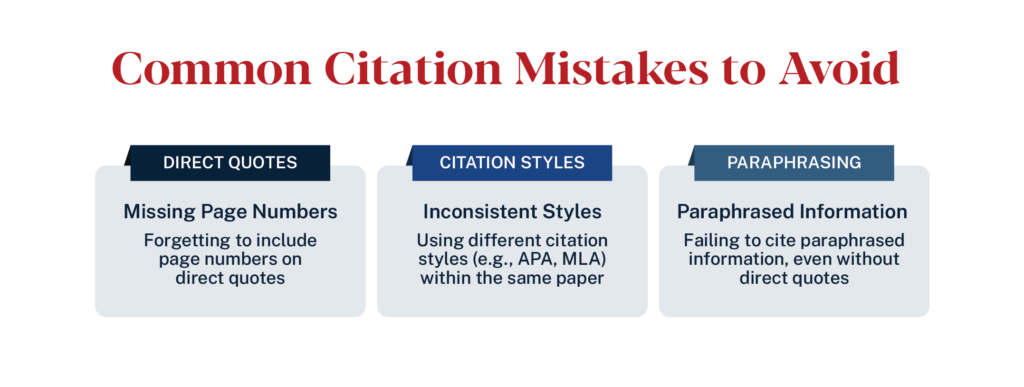
- Forgetting to cite paraphrased information
- Leaving out page numbers for direct quotations when required
- Mixing APA and MLA citation styles in the same paper
- Including an in-text citation without a matching reference list entry
- Listing sources in the reference section that don’t appear in the paper
- Using inconsistent formatting throughout your citations
Reviewing your citations before submitting your paper can help you catch these mistakes and ensure your sources are cited consistently.
Tips for Citing Sources Accurately
Accurate citations start with good research habits. A few simple practices can make the process easier:
- Track your sources as you research instead of trying to recreate citation details after you’ve finished writing
- Save important information, including publication dates, page numbers and URLs, as you gather sources
- Use citation management tools like Zotero, Mendeley or EndNote to organize sources and generate citations
- If you use a citation generator, review each citation for formatting errors or missing information before adding it to your paper
- Double-check your citations against the style guide required by your instructor, school or publisher, and use that citation style consistently throughout your paper
Citing Sources With Confidence
Citing sources correctly helps protect academic integrity and strengthens the credibility of your research. While APA, MLA and other citation styles use different formatting, they all serve the same purposes: giving credit to the original author and helping readers trace information back to the source.
The more you practice citing sources, the more natural the process becomes. Building strong citation habits now can help you approach future assignments with greater confidence and make academic writing a little easier each time.
FAQs
What’s the difference between an in-text citation and a reference list entry?
An in-text citation briefly identifies a source within the body of your paper when you quote, paraphrase or reference someone else’s work. A reference list entry appears at the end of your paper and includes the complete publication information readers need to locate the original source.
Do I need to cite a source if I paraphrase instead of quote?
Yes. Paraphrasing changes the wording of a source, but the original idea still belongs to another author. Whenever you paraphrase someone else’s work, you should include an in-text citation and add the full source to your reference list.
What citation style should I use for my paper?
The style of citation you use depends on your instructor, institution, discipline or publisher. APA style is commonly used in education, psychology, healthcare and the social sciences, while MLA is often used in humanities courses. At American College of Education (ACE), students are expected to write papers and cite sources using APA style.
How do I cite a source with no listed author?
If no author is listed, start the citation with the title of the source and format it according to the citation style you’re using. For in-text citations, use a shortened version of the title in place of the author’s name, then include the full source information in your reference list or Works Cited page.
Can I use a citation generator instead of formatting citations manually?
Yes. Citation generators can save time and help reduce formatting errors, but they aren’t always accurate. Review each generated citation against the official style guide or your instructor’s requirements to make sure the information is complete and formatted correctly.
The MLA Style Center and APA Style Guide were consulted while writing this article.
American College of Education offers affordable programs that are friendly to working professionals returning to school after extended time away from academia. Our robust writing center and student support resources help our students tackle research papers and scholarly writing with confidence.