
American College of Education (ACE) is deeply proud of its graduates and their accomplishments. This blog is inspired by Ed.D. in Curriculum and Instruction alumna, Dr. Nneka J. McGee’s dissertation research. You may also read it in full.
Unlike many previous educational technology innovations, artificial intelligence (AI) has advanced rapidly, reshaping how tasks such as writing, grading, data analysis and content creation are performed.
In education, AI-powered tools are increasingly capable of automating instructional and administrative processes, raising important questions about how teaching and learning may change as these technologies become more prevalent in K–12 classrooms. As school districts explore the possibilities of AI integration, educators are often expected to adapt quickly and sometimes without clear guidance, training or policy support.
The growing presence of AI in education has generated both optimism and concern. While proponents point to increased efficiency, personalized learning and enhanced student engagement, critics raise ethical questions related to data privacy, bias and the role of human educators. Amid these competing perspectives, understanding how teachers experience AI integration in real classroom contexts is essential.
McGee’s research examined how educators perceive AI, the professional development opportunities available to them, and the extent to which school districts support responsible and effective AI integration. To better understand these experiences, McGee’s research sought to answer the following questions:
- Research Question 1: What are teachers’ lived experiences with implementing artificial intelligence applications in K–12 learning environments in the United States?
- Research Question 2: What are teachers’ lived experiences with professional development opportunities related to implementing artificial intelligence applications in K–12 learning environments in the United States?
Expecting K-12 Educators to Implement AI
As AI becomes more embedded in educational technology, K–12 teachers are increasingly expected to incorporate AI-powered tools into their instructional practices. These tools may support tasks such as lesson planning, assessment and student engagement, yet many educators report limited experience and minimal professional development related to AI implementation.
The problem explored in this study is that K–12 teachers in the U.S. often lack sufficient preparation and institutional support to implement AI effectively in classroom environments. Without clear district-level guidance, teachers may be left to navigate AI integration independently.
The purpose of McGee’s qualitative phenomenological study was to explore the lived experiences of K–12 teachers who are either implementing AI in their classrooms or preparing to do so. The study sought to understand educators’ experiences with AI-powered tools and the professional development opportunities available to them. By examining these perspectives, the research aimed to inform educational leaders and policymakers about how to better support teachers as AI continues to influence K–12 education.
Previous Studies: AI in K-12 Classrooms
McGee conducted extensive secondary research to examine what researchers already know about artificial intelligence in education and where gaps remain. While the literature points to AI’s growing presence in classrooms, it also highlights persistent concerns about teacher preparedness, ethical guidance and the challenges of implementing new technologies at scale, especially after the rapid shift to virtual learning during the COVID-19 pandemic.
AI’s Expanding Role in Education
Prior studies show that AI in education is not entirely new. Researchers have documented early applications such as intelligent tutoring systems and intelligent learning environments, along with emerging tools that include chatbots, robotics and AI-powered learning programs.
As these technologies continue to advance, they are increasingly shaped by Industry 4.0, the current phase of technological development characterized by automation, AI and highly connected digital systems that are transforming how work is performed across industries.
In education, this shift supports more adaptive, student-centered approaches aligned with Education 4.0, a model of schooling that responds to Industry 4.0 by emphasizing agile learning, student choice and AI-powered systems that continuously adapt to learners’ needs.
Ethical Concerns and Data Privacy in AI Integration
A major theme across the literature involves ethical considerations – particularly issues related to privacy, transparency, bias and responsibility. Because AI systems rely on large volumes of data, researchers emphasize that schools and policymakers must consider how student information is protected and how AI tools align with ethical principles and educational regulations.
Personalized Learning and the Challenge of Teacher Capacity
McGee’s literature review also highlights AI’s role in personalized learning, where tools can adapt instruction to student needs and learning styles. At the same time, researchers note that implementing personalized learning through AI can increase demands on teachers, especially when job-embedded training is limited. Without adequate professional development and support, teachers may resist implementation or revert to familiar instructional practices when challenges arise.
Will AI Replace Teachers or Support Them?
Some studies explore the idea that AI could replace teachers, often framed as a solution to efficiency or staffing challenges. However, the literature also emphasizes a key limitation: AI lacks the emotional intelligence and human adaptability that educators provide. A more common framing across the research is that AI can support teachers through tools that reduce workload, such as systems that assist with feedback, communication and repetitive administrative tasks.
Barriers to AI-Powered Support in Schools
Even when AI tools exist to support educators, researchers identify barriers that can prevent effective adoption. Teacher training is frequently cited as a primary concern, and the literature suggests that even when training is available, it may not be comprehensive enough to support consistent usage. Prior research also indicates that teacher involvement in the adoption process can influence buy-in and implementation success.
Generation Alpha and Ongoing Concerns About Implementation
McGee’s review also examines Generation Alpha (students born during or after 2010) and how their deep exposure to technology may shape learning environments influenced by AI. Across the literature, common concerns emerge repeatedly: privacy, cost, bias and discrimination, and uneven understanding of AI concepts in educational settings. McGee also notes a counterargument in the literature: that AI could be a technological trend that fails to reach its anticipated impact.
Discovering K-12 Educator Lived Experiences
McGee’s qualitative study followed a phenomenological research design, an approach used to understand how individuals experience a shared phenomenon. In this case, the study focused on the lived experiences of K–12 teachers in the U.S. who were either implementing AI in their classrooms or preparing to do so.
Participants were selected using established inclusion criteria and represented educators working across K–12 learning environments. Data were collected through questionnaires and semi-structured interviews, which allowed teachers to share detailed perspectives on their experiences with AI, professional development opportunities and institutional support. The interview protocol included guiding questions while also allowing space for participants to elaborate on their individual experiences.
McGee prepared the collected data and applied a systematic qualitative analysis process to identify patterns and recurring ideas across participant responses. To strengthen the trustworthiness of the study, she followed recommended qualitative research practices, including careful documentation of procedures and alignment between the research questions, data collection methods and analysis.
Data Analysis: Where K-12 Educators Need Leadership Support
McGee analyzed participant responses using a qualitative thematic analysis process. Interview and questionnaire data were carefully reviewed, coded and compared to identify recurring patterns across teachers’ experiences.
Several overarching themes emerged from the analysis, reflecting how K–12 teachers experience AI implementation in classroom settings. These themes centered on self-directed AI use, limited professional development, ethical and policy uncertainty, leadership readiness, and AI as a support tool rather than a replacement for teachers. Together, they reveal how educators are navigating AI integration in the absence of consistent district-level guidance.
Research Question 1: Teachers’ Lived Experiences With Implementing AI
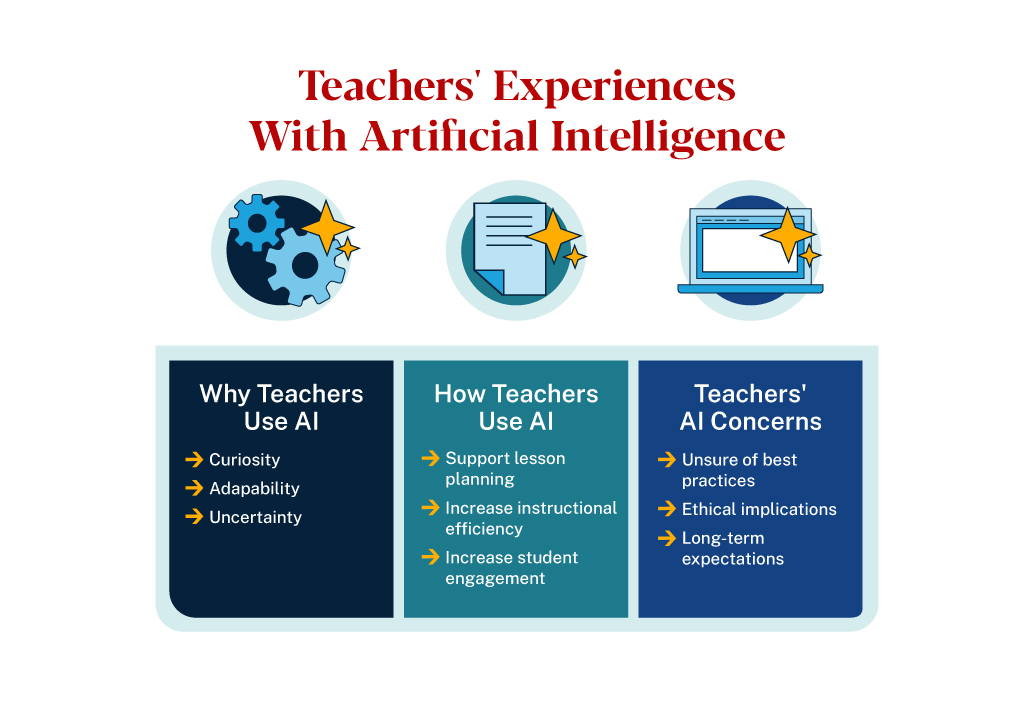
The first research question examined teachers’ lived experiences with implementing AI applications in K–12 learning environments. Participants described using AI tools primarily in practical and exploratory ways, often to support lesson planning, instructional efficiency or student engagement. In many cases, teachers reported learning about AI independently rather than through formal district initiatives.
Themes associated with this research question indicate that teachers’ experiences with AI implementation were shaped by curiosity and adaptability, but also by uncertainty. Educators expressed concerns about best practices, ethical implications and long-term expectations related to AI use. Collectively, the themes suggest that AI implementation often occurs in fragmented and individualized ways rather than as part of a coordinated instructional strategy.
Research Question 2: Professional Development and Support for AI Implementation
The second research question focused on teachers’ lived experiences with professional development opportunities related to AI implementation. Participants consistently reported limited access to professional learning specifically focused on artificial intelligence. When training was available, it typically emphasized general technology integration rather than AI-specific applications, ethical considerations or classroom use cases.
As a result, many educators relied on informal learning methods such as peer collaboration, independent research, and trial-and-error experimentation. Themes associated with this research question highlight a gap between district expectations for AI integration and the professional development opportunities provided to support those expectations. Together, the findings underscore the importance of intentional leadership involvement, clearer guidance and sustained professional learning to support teachers as AI becomes more prevalent in K–12 education.
Providing Professional Development and AI Integration Training
McGee determined that K–12 teachers are increasingly using AI in their classrooms but often do so without sufficient professional development or district-level guidance. While educators recognized AI’s potential to support instruction and efficiency, many described uncertainties related to ethical use, best practices and long-term expectations. These findings suggest that teachers’ experiences with AI implementation are shaped more by self-directed learning than by coordinated leadership strategies.
Because this study focused on a specific group of K–12 educators, the findings may not reflect all school contexts or district approaches to artificial intelligence. McGee recommends future research that examines AI implementation across diverse educational settings and explores how sustained professional development influences teacher confidence and instructional practices over time.
For the future of AI in K–12 education, McGee recommends intentional, ongoing professional development focused on AI-specific applications, ethics and classroom integration. She also emphasizes the importance of clear leadership guidance that positions AI as a support tool rather than a replacement for teachers. By centering educator voice and preparedness, school districts can better implement AI in ways that enhance teaching and learning.
American College of Education (ACE) supports educators as they navigate evolving instructional technologies. ACE’s online doctoral programs prepare educational leaders to make informed, ethical decisions that strengthen learning environments and support teacher success.